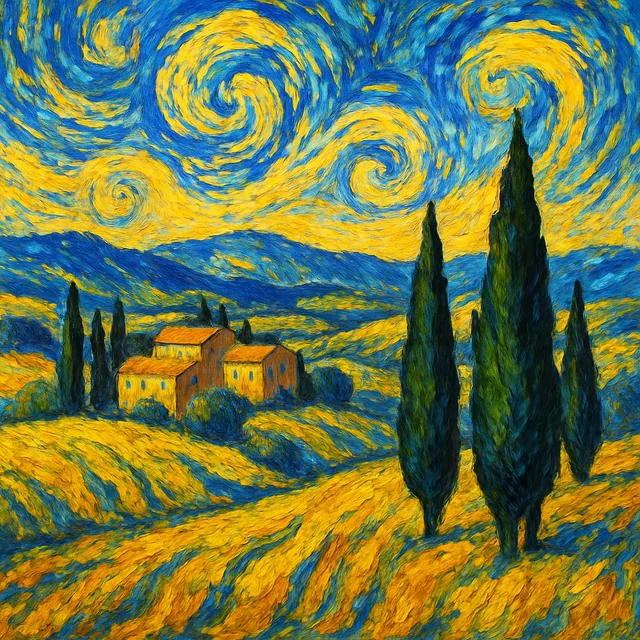
Painting Styles for Your Photo: Van Gogh, Monet and Munch
Eight famous painting styles you can apply to a photo with AI, what each one does to colour, brushwork and faces, and which kinds of photo suit each style.
Also in:TürkçeDeutschEspañolPortuguêsFrançais日本語Bahasa Indonesiaالعربيةहिन्दी

On this page
- The styles at a glance
- Van Gogh: movement and thick paint
- Monet and Impressionism: light over line
- Munch and Expressionism: mood first
- Klimt: gold and ornament
- Hokusai and Japanese woodblock prints
- Rembrandt and Vermeer: the portrait painters
- Picasso and Cubism: for posters, not likeness
- How to get a good result
- A note on living artists
You can apply many famous painting styles to a photo with AI, and each one changes the image in a different way. Van Gogh swirls the sky and thickens the paint. Monet dissolves edges into dabs of light. Munch bends everything towards unease. Knowing what each style actually does helps you choose the right one for a particular photo, and avoid styles that will flatten a face or turn a busy scene into mush.
For how style transfer works under the hood, and why Van Gogh is so popular in particular, read Van Gogh style AI filters: how they work. This guide is a tour of the options.
The styles at a glance
| Style | What it changes | Best photos | Faces |
|---|---|---|---|
| Van Gogh | Thick, swirling strokes; strong blue and yellow | Night skies, fields, trees | Lose detail |
| Monet / Impressionism | Soft dabs of colour, light over line | Water, gardens, misty mornings | Soft, low detail |
| Munch / Expressionism | Wavy lines, uneasy colour | Moody portraits, dusk scenes | Distorted on purpose |
| Klimt | Gold, flat ornament, mosaic pattern | Portraits, couples | Face kept, body decorated |
| Hokusai / ukiyo-e | Flat colour, bold outlines, woodblock texture | Sea, mountains, bridges | Simplified |
| Rembrandt / Baroque | Deep shadow, one warm light source | Portraits, still life | Well kept |
| Vermeer | Quiet window light, cool blues and yellows | Indoor scenes, portraits by a window | Well kept |
| Picasso / Cubism | Broken planes, multiple viewpoints | Portraits for a bold poster | Fragmented |
Van Gogh: movement and thick paint
Van Gogh's late style turns flat areas into movement: skies swirl, fields ripple, cypress trees flicker like flames. Colours push towards strong blues, yellows and greens. It is spectacular on landscapes with a big sky, night scenes and anything with trees.
The same energy works against portraits. The face becomes a pattern of strokes, so likeness drops. If you want a portrait, keep the face large in frame and ask for a lighter version of the effect.
Monet and Impressionism: light over line
Impressionism cares about how light falls rather than where edges are. Shapes dissolve into short dabs of colour, shadows become violet and blue, and water shimmers. Photos of ponds, gardens, coastlines, cafés and misty mornings take to it well.
Fine detail disappears, which is part of the charm. A cluttered street photo becomes a pleasant blur; a single figure on a bridge becomes a painting. If you prefer something lighter and more transparent, a watercolour restyle is a close cousin; see how to create a watercolor painting from your photo.
Munch and Expressionism: mood first
Expressionism distorts on purpose to show feeling. Lines wave, skies turn orange and red, and figures stretch. It suits moody portraits, dusk photos and anything you want to feel dramatic or unsettling.
Expect faces to be changed. That is the point of the style, but it means it is a poor choice for a gift where the person must be recognised.
Klimt: gold and ornament
Klimt's best-known work places realistic faces and hands inside flat, decorative fields of gold, spirals and mosaic shapes. In AI restyles, this often keeps the face surprisingly intact while turning clothing and background into pattern.
That makes it one of the best painterly choices for portraits and couples. Our guide to AI couple portraits covers how to frame two people so both faces survive.
Hokusai and Japanese woodblock prints
The ukiyo-e woodblock style uses flat areas of colour, strong outlines, stylised waves and a visible paper texture. It suits seascapes, mountains, bridges and city scenes with clear geometry. Busy foliage and crowds become noise, so choose a photo with a few big shapes.
Rembrandt and Vermeer: the portrait painters
If likeness matters, look to the old masters of light. A Rembrandt-like restyle adds deep shadow and one warm light source, which flatters most faces and keeps structure. A Vermeer-like restyle adds soft side light from a window, cool blues and warm yellows, and a calm interior feel.
Both work best when the source photo already has light coming from one side. A flash-lit selfie gives them little to build on.
Picasso and Cubism: for posters, not likeness
Cubism breaks a subject into flat planes and shows several angles at once. It is fun for a bold poster or album-style cover, and almost always loses likeness. Treat it as an art piece rather than a portrait.
How to get a good result
- Choose the photo for the style. Big sky for Van Gogh, water for Monet, side light for Rembrandt.
- Describe qualities as well as names. "Impressionist painting, soft dabs of colour, violet shadows, morning light" is more reliable than "Monet" alone.
- Say what to keep. "Keep the composition and the face recognisable" helps the model hold back.
- Run several variations. Painterly styles vary a lot between runs; compare a few.
- Upscale for print. A painted result printed large needs more pixels than a phone screen.
The Style Transfer tool lets you describe a painter's look in plain words in the browser studio, and works on landscapes, portraits and pets. For animals, the pet portrait guide covers which photos hold up. If you want to compare different apps for this, see the best AI style transfer apps compared.
A note on living artists
Every painter in this guide died long ago. Imitating the recognisable style of a living artist is a different matter: it can affect their livelihood, and the law around it is unsettled. The respectful approach is to describe the visual qualities you want rather than naming a working artist.
Frequently asked questions
- Which painting style works best for portraits?
- Styles that keep the structure of the face: Rembrandt-like chiaroscuro, Vermeer-like soft window light and Klimt-like decoration around a realistic face. Van Gogh and Munch styles are expressive, so the face tends to lose likeness.
- Which painting style works best for landscapes?
- Impressionism in the manner of Monet, and Van Gogh's swirling style, both suit landscapes with a clear horizon and open sky. Hokusai-style woodblock prints suit coastlines, mountains and waves.
- Is it legal to use a famous painter's style?
- The painters in this guide died long ago and their work is in the public domain. Style itself is generally not protected by copyright, though the legal position on AI models trained on copyrighted work is still contested. Naming long-dead artists and describing visual qualities is the safer ground.
- Will the AI copy a specific painting?
- No. It reproduces visual qualities associated with the style, such as stroke, palette and texture. It is not pasting pieces of real paintings and cannot reproduce a specific one exactly.
- Can I print a painted version of my photo?
- Yes. For larger prints, upscale the result first, and pick a source photo with strong, simple shapes so the painted detail holds up at size.
Ready to put this into practice?
Create with Kitana using the tool that fits this guide.
Turn a photo into a paintingReady to try it yourself?
Try it in your browser in under a minute, or take it with you in our mobile app.
Turn a photo into a painting